
A rotary screw compressor works by trapping atmospheric air between two interlocking helical rotors and squeezing it into a progressively smaller space as the rotors turn. The result is a continuous, non-pulsating stream of compressed air rather than the pulsed output of a piston machine. That single design difference is why rotary screw models dominate commercial and industrial compressed air systems.
There are two circuits running inside the machine at the same time, and understanding how a rotary screw compressor works means following both. The air circuit converts atmospheric air into clean, dry compressed air. The oil circuit keeps the machine sealed, cooled and lubricated while that happens. The diagram and step-by-step walkthrough below trace each of them from inlet valve to discharge.
What Is a Rotary Screw Air Compressor?
A rotary screw air compressor is a positive displacement compressor that uses two meshing helical rotors, one male and one female, to compress air. As the rotors counter-rotate inside a sealed housing, the volume of the pocket holding the air shrinks continuously along the length of the rotors until the air reaches its designed pressure and exits through the discharge port.
Because compression is continuous rather than reciprocating, a rotary screw compressor delivers steady flow with very little pulsation or vibration. These machines are built to run at a 100% duty cycle, meaning they can operate around the clock without a rest interval, and they typically last far longer between rebuilds than piston compressors of comparable output.
That combination of continuous output, reliability and low operating cost is why most air compressors used in commercial and industrial settings are rotary screw models, and why anyone responsible for maintaining a compressed air system benefits from understanding what happens inside one.
Rotary Screw Compressor Diagram
The diagram below shows the complete path of both circuits through an oil-injected rotary screw compressor. The color legend distinguishes ambient air, compressed air, hot compressed air, cold lubrication oil, hot lubrication oil and the oil-air mixture, so you can follow either circuit independently. Each labeled component appears in the key that follows.

How to Read the Diagram
The legend splits the diagram into six flows. Light blue is ambient air being drawn in. Dark blue is compressed air. Purple is hot compressed air leaving the airend before it has been cooled. Yellow is cold lubrication oil on its way back to the compression chamber. Orange is hot lubrication oil heading for the cooler. The dark band is the oil-air mixture that exists only between the airend discharge and the separator tank.
Follow the air first. It enters at the intake air filter, passes the intake valve, and is compressed in the airend. It leaves as an oil-air mixture into the air-oil separator tank, exits through the separator element and minimum pressure valve, runs through the aftercooler, and finishes at the moisture separator before reaching the compressed air outlet.
Now follow the oil. It is injected into the airend, leaves mixed with the air, drops out in the separator tank, and returns through the thermal valve. Cold oil goes straight back to the airend. Hot oil is routed through the oil cooler first. Either path passes the oil filter before re-entering the compression chamber. The two circuits meet in exactly two places: inside the airend where the oil is injected, and inside the separator tank where it is removed.
How a Rotary Screw Compressor Works, Step by Step
The compression cycle breaks into five stages. Air moves through all five in a continuous stream, so at any moment during normal operation every stage is active at once.
Step 1: Air Enters Through the Inlet Filter and Inlet Valve
Atmospheric air enters the compressor through an inlet air filter and an inlet valve. The filter removes particulate before anything reaches the rotors. The inlet valve controls how much air is drawn into the unit, and it has two positions that matter operationally. It sits wide open when the compressor has demand and is loaded. It closes when there is no demand and the machine drops into a no-load state.

One note on atmospheric conditions: intake air pressure varies considerably with elevation, which affects the volume of air the machine can draw and is a factor in correctly sizing a compressor for a given site.
When the compressor reaches its designated unload pressure, the package relieves internal pressure to reduce power consumption while continuing to run in the no-load state. In practice, the compressor often switches back into the loaded state before the transition to no-load has finished. When that happens repeatedly, the result is rapid cycling, which puts real mechanical stress on the unit and can damage it over time. If you are seeing rapid cycling, have an air compressor professional evaluate the system before it becomes a failure.
Step 2: Air Is Compressed in the Airend
Intake air passes from the inlet valve into the compression chamber, known as the airend. Inside it, two interlocking helical rotors mesh together, trapping air between the rotor lobes and the surrounding casing. The rotors turn in opposite directions, and as they turn the trapped pocket of air travels along their length while its volume steadily decreases. Reducing the volume raises the pressure. An electric motor typically drives the male rotor, which in turn drives the female rotor.
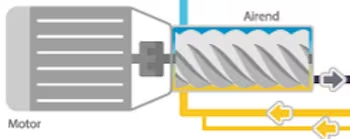
Compression is not a single event in a rotary screw machine. It happens continuously as the pocket moves down the rotors, which is why the discharge is a steady stream rather than a series of pulses. The pressure the machine can reach in a single stage is set by the length and pitch of the rotors and by the design of the discharge port.
Why the Rotors Do Not Touch
In an oil-injected design, oil is injected directly into the compression chamber, where it coats the rotors. That film does three jobs at once. It seals the clearances between the rotors and the casing so compressed air cannot leak backward, it carries away a large share of the heat that compression generates, and it reduces wear on the rotor surfaces, which extends the working life of the airend. Oil-free compressors are available for applications that cannot tolerate any oil contact, but most operations choose oil-lubricated models because they cost less and run more efficiently.
The trade-off is that the lubricant injected into the compression chamber leaves the chamber mixed into the compressed air. That oil has to come back out.
Step 3: Oil Is Removed in the Air-Oil Separator
The air-oil mixture discharges into the sump, also called the air-oil separator tank. On entry it strikes a series of baffles that redirect the flow into a centrifugal motion. The resulting vortex throws the heavier oil droplets outward against the tank walls, where they run down and collect in the bottom. Any oil still suspended in the airstream is captured by a filter element at the top of the separator.

Air leaving the separator carries less than 3 parts of oil per million, which is clean enough for the large majority of industrial applications. For operations with stricter air quality requirements, such as semiconductor fabrication, food and beverage production and medical equipment manufacturing, additional downstream filtration can bring that figure down to .01 PPM.
The air is clean at this point but not yet usable. Compression generates heat, so the air leaving the separator is still too hot to release into the distribution system, and it is saturated with moisture that would damage downstream equipment.
Step 4: The Air Is Cooled in the Aftercooler
The compressed air moves next into an air-cooled aftercooler, a heat exchanger in which a fan blows ambient air across finned tubes. As the aftercooler pulls heat out of the compressed air it lowers the pressure dew point, and water vapor that the hot air was holding condenses into liquid. A typical aftercooler operates with an approach temperature of 15°F-18°F, meaning the discharged air leaves within that range of the ambient air temperature.

Cooling the air is what makes the final stage possible. Cool air holds far less moisture than hot air, so the aftercooler is what forces the water out of suspension where it can be captured and drained.
Step 5: Water Is Removed in the Moisture Separator
In the last stage before the compressed air enters the plant system, a moisture separator extracts the condensate the aftercooler produced. The collected water leaves the separator through a drain valve, either on a timer or on demand depending on the drain type installed.
For many facilities, the moisture separator alone is not enough. Depending on the pressure dew point and air quality a given process requires, a rotary screw compressor system may also include an air dryer. Refrigerated dryers chill the air to force out additional moisture and are the common choice for general industrial use. Desiccant dryers use an adsorptive material to pull water vapor out of the air and reach much lower dew points, which matters in applications where any moisture is a defect risk. Automotive, semiconductor and electronics operations frequently specify one or the other.
The Oil Circuit: The Lifeblood of the System
Everything above traces the air. Running alongside it is a second circuit that determines how long the machine lasts. Oil is the lifeblood of a rotary screw compressor: it reduces friction between the moving parts, limits heat buildup, and seals the compression chamber so the machine can do its job efficiently.
Oil Is Injected Into the Compression Chamber
Oil enters at the compression chamber, where it coats and seals the rotors. That coating reduces wear on the rotor surfaces and keeps both the machine and the air passing through it from overheating. As the air is compressed, tiny droplets of oil mix into it. Because most applications require clean air, that oil then has to be separated back out, which is the reason the oil circuit and the air circuit share the same separator.
Oil Is Separated From the Air
The separator does double duty. Step 3 covered how it cleans the air. On the oil side, the same vortex that drives oil out of the airstream is what collects it for reuse. The oil runs down the tank walls, pools in the bottom and is drawn into an oil return line. A scavenge line feeds whatever the coalescing filter element catches back into the circuit rather than letting it accumulate. Nothing is discarded. The oil that leaves the airend is the oil that returns to it.
Oil Is Cooled, Filtered and Recycled
In most applications a thermostatic valve reads the oil temperature and splits the flow. Oil that is already cool enough goes straight back to the airend. Oil that is too hot is routed through an oil cooler first. Some newer variable speed fan-cooled compressors send all of the lubricant through the oil cooler and vary the fan speed instead to hold the target temperature.
Either way, the oil then passes through a filter that removes contaminants capable of damaging the compressor, and returns to the airend, where the cycle begins again.
Rotary Screw Compressor Components Explained
The table below summarizes the major components in an oil-injected rotary screw compressor and what each one contributes to the cycle. It doubles as a reference key for the diagram earlier in this article.
| Component | Circuit | What It Does |
|---|---|---|
| Airend | Air | The compression chamber housing the rotors. The core of the machine and the component most affected by lubrication quality. |
| Male and female rotors | Air | Interlocking helical screws. The male rotor is driven by the motor and drives the female rotor. |
| Inlet valve | Air | Modulates intake volume and closes the machine off from atmosphere in the unloaded state. |
| Inlet air filter | Air | First line of defense against particulate reaching the rotors. |
| Drive motor | Air | Powers rotation. Fixed speed or variable speed depending on configuration. |
| Air-oil separator | Both | The point where the two circuits split. Removes oil from the compressed air and collects it for reuse. |
| Aftercooler | Air | Lowers discharge temperature and pressure dew point so moisture can be removed. |
| Moisture separator | Air | Captures condensate created by the aftercooler and routes it to the drain valve. |
| Oil cooler | Oil | Removes heat from the lubricant before it returns to the compression chamber. |
| Oil filter | Oil | Removes contaminants from the lubricant on the return path to the airend. |
| Thermostatic valve | Oil | Decides whether returning oil needs the cooler or can go straight back to the airend. |
| Coalescing filter element | Oil | Captures fine oil mist the separator baffles miss and feeds it to the scavenge line. |
Types of Rotary Screw Compressors
The working principle is the same across the category, but three configuration choices change how a given machine behaves in a plant.
Oil-Injected vs. Oil-Free
Oil-injected machines inject lubricant into the compression chamber to seal, cool and lubricate, which allows higher pressures in a single stage and better efficiency at lower cost. Oil-free machines keep lubricant entirely out of the compression chamber, using timing gears to hold the rotors in alignment without contact and specialized coatings in place of an oil film. Oil-free units eliminate any possibility of oil carry-over, which some processes require outright, but they cost more, run louder and typically need multiple compression stages with interstage cooling to reach comparable pressures. Our KROF two-stage oil-free rotary screw air compressor is built for exactly those applications.
Single-Stage vs. Two-Stage
A single-stage compressor compresses air once between one pair of rotors. A two-stage compressor splits the work across two rotor sets with cooling in between, which reduces the work required at each stage and improves efficiency, particularly at higher pressures and long run hours. Kaishan’s KRSP and KRSP2 rotary screw air compressors cover both configurations and are backed by a lifetime warranty on the airend.
Fixed Speed vs. Variable Speed
A fixed speed compressor runs its motor at a constant rate and manages output by cycling between loaded and unloaded states, which is efficient only when demand is steady and close to full capacity. A variable-speed drive compressor changes motor speed to match actual air demand, so it draws only the power the current load requires. In facilities where demand swings across shifts or seasons, that difference shows up directly in the energy bill, which for most compressed air systems is the largest component of lifetime cost.
How a Rotary Screw Compressor Compares to a Piston Compressor
The most common alternative in industrial settings is the reciprocating, or piston, compressor, and the two work on entirely different principles. A piston compressor draws air into a cylinder and compresses it with a piston driven by a crankshaft, which produces a pulsed output rather than a steady stream. It also needs time to cool between cycles, so it runs at a much lower duty cycle. A rotary screw machine compresses continuously, runs quieter and lasts considerably longer between rebuilds, but costs more upfront.
That is the short version. For a full side-by-side comparison covering reciprocating, rotary screw and centrifugal machines together, along with recommendations by industry and by business objective, see our guide to the types of air compressors.
Maintenance That Keeps the Cycle Running
Understanding the anatomy of a rotary screw compressor makes the maintenance schedule self-explanatory. Every stage in the cycle depends on a filter, a cooler or a drain doing its job, and each of those is a consumable.
- Change air and oil filters on the manufacturer’s prescribed intervals. A restricted inlet filter forces the machine to work harder for the same output; a loaded oil filter puts contaminated lubricant back into the airend.
- Inspect drains and sumps regularly to prevent blockages. A blocked condensate drain sends water downstream into the distribution system.
- Follow the oil analysis routine the manufacturer specifies. Routine analysis tells you the condition of the oil before a problem becomes a repair, and it can surface a developing failure early enough to schedule around it.
- Check the oil level before starting the compressor each day, using the sight glass or equivalent indicator on the separator tank. Oil declines steadily over time as droplets are absorbed into the air and removed by the coalescing filters and drainage system.
- Change the compressor oil on schedule. This is not optional if the goal is peak operating efficiency and maximum uptime.
- Keep the aftercooler and oil cooler clean. Fouled heat exchangers raise discharge temperature across the whole machine.

Consult your manufacturer’s instructions for the specific intervals that apply to your model and operating environment. A machine running in a dusty plant will need filter and oil service more frequently than one in a clean, climate-controlled compressor room.
If your compressor suddenly starts consuming more oil than usual, treat it as a signal rather than a nuisance. Excess oil consumption typically points to a leak somewhere in the circuit or an operating temperature that has climbed too high, and both are worth diagnosing before they cascade.
Frequently Asked Questions
Key Takeaways
- Two circuits, not one. A rotary screw air compressor runs an air circuit and an oil circuit simultaneously, and they meet in exactly two places: the airend and the separator tank.
- Compression is continuous. The trapped pocket of air shrinks steadily as it travels along the rotors, which is why discharge is a steady stream rather than a pulse.
- Oil has to come back out. Small amounts of oil are injected into the air as it is compressed, and the separator removes it to meet the requirements of end-use applications.
- Oil is the lifeblood of your compressor. It seals the rotors, carries away heat and reduces wear. Routine oil maintenance is the most effective way to ensure compressor longevity.
- Anatomy explains maintenance. Every stage in the cycle depends on a filter, a cooler or a drain, and each of those is a consumable on a schedule.
Let Us Help
Knowing how a rotary screw compressor works is the starting point. Applying that to your plant, correctly sizing the machine, choosing between single-stage and two-stage, deciding whether variable-speed drive pays for itself at your duty profile, is where a local expert earns their keep.
We partner with independent, local distributors because it is the best way to serve you. Unlike large corporate suppliers, there is no red tape here. Our independent distributors offer expert guidance, faster response times and personalized support tailored to your needs. They do not just sell compressors. They build relationships, ensuring you get the right system, reliable service and quick access to parts when you need them most.
With factory-trained technicians and a deep understanding of industrial applications, they help maximize efficiency and minimize downtime. So when you buy through Kaishan, you are getting more than a product. You are getting a local partner who cares about your business and seeing it succeed.
We can help you design your air compressor system and maintain your rotary screw air compressor to optimize its operation in your plant. Get in touch with the experts at Kaishan. Contact us today.